From Skeptics to Believers: How AI can Transform the Chip Design Industry
The EDA (Electronic Design Automation) industry veterans, accomplished professors, and incumbent giants—Cadence, Synopsys, and Siemens EDA—were once the fiercest critics of using AI for chip design. Today, they've become its most vocal proponents.
This article isn't meant to criticize these companies or experts. Rather, it's an introspection on how a growth mindset enables disruptive innovation that even the smartest and most successful organizations can fail to anticipate.
Even the "Smartest" People Have Blind Spots
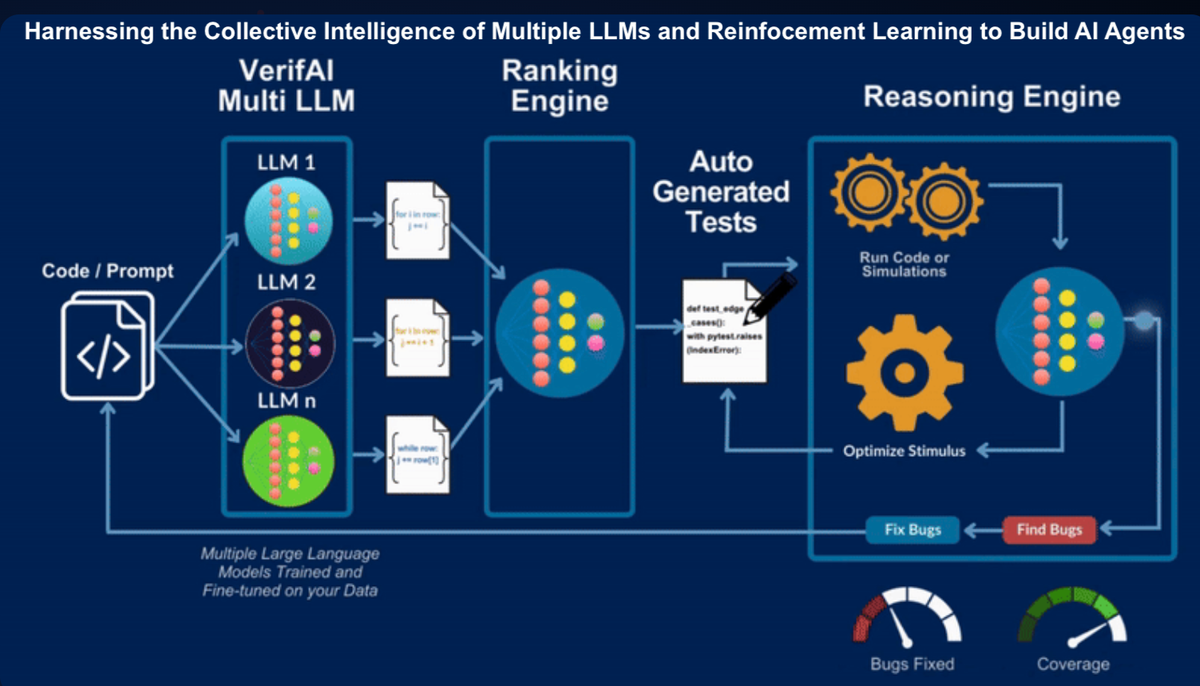
At DAC 2022 (July 10–14, 2022), I participated in a panel alongside Clark Barrett (Stanford University), Avi Ziv (IBM Research), and Erik Berg (Microsoft). I made a bold prediction: "The future of verification and chip design will hinge on the use of Reinforcement Learning and Language Models."
The audience fell silent. The panelists were visibly shocked. The AMD representative organizing the panel was in disbelief that I'd mentioned language models in the context of design verification. Keep in mind—this was before ChatGPT's release in November 2022.
The Panel That Missed the Mark
Vighnesh Iyer captured the sentiment in his DAC 2022 recap blog, describing the panel "ML for Verification: Does it Work or Doesn't It?" The panelists included:
- Clark Barrett — Stanford University (the ML skeptic and formal methods advocate)
- Erik Berg — Microsoft
- Sandeep Srinivasan — VerifAI (the ML enthusiast)
- Avi Ziv — IBM
- Shobha Vasudevan — Google Brain (absent)
Industry expert and panel moderator Brian Bailey later wrote an article titled "Can ML Help Verification? Maybe", highlighting the industry's struggle to make meaningful progress with machine learning in functional verification.
The skepticism was palpable.
Clark Barrett stated: "I've seen a lot of examples of people trying to use AI for problems it is not well suited for. There are things AI is really good at, but if you need to do precise reasoning, if you need to find bugs that nobody's seen before—then maybe AI is just not the right tool for the job."
Meanwhile, I argued: "We pay the smartest human beings—our engineers—to sift through log files. With 40,000 failures a week, using natural language processing on unstructured log data can dramatically speed up debug and decision-making. It's not a silver bullet, but there's a huge opportunity to save time and resources across multiple categories."
The Lesson: Maintain an Open Mind and Growth Mindset
These anecdotes underscore a critical point: as an industry, we must keep an open mind and cultivate a growth mindset.
Approximate computing—solving hard problems by allowing neural networks to learn—shouldn't be dismissed as inferior to closed-form solutions or formal methods. We still have limited understanding of how neural networks, including transformer models, learn and produce unexpected results. These characteristics can be intimidating to traditional engineers and mathematicians (though perhaps less so to physicists).
When AI models challenge everything we've learned and perform better, it's deeply unsettling for many of us. But discomfort shouldn't prevent progress.
What's Ahead: Multiple Paradigm Shifts in Chip Design
There has been pent-up demand for innovation in Semiconductor Engineering for decades. Semiconductor engineers have long been at the mercy of EDA companies to provide "smart closed-form solutions" to challenging problems like placement, routing, static timing analysis (STA), simulation, and verification.
The Empowered Engineer
The semiconductor engineer is evolving. Empowered by AI coding assistants like GitHub Copilot, Claude Code, and Gemini CLI.
Semiconductor Engineers are no longer passive consumers of EDA products—and they're certainly not hostage to the industry's slow pace of innovation.
However, the EDA industry has historically protected its franchise by maintaining a closed ecosystem, allowing minimal innovation on chip-design work flows, from semiconductor customers. While this may have seemed like sound business practice, in today's environment, this dynamic is working against monopolies and the EDA establishment.
From Closed Solutions to Open Competition
The EDA industry's closed-form solution mindset has been its greatest asset. In today's era of approximate solutions, it may become its greatest liability.
Here's why: EDA tools will be used by AI agents built by semiconductor engineers, which will naturally gravitate toward the best performing and cost-effective solutions. The differences between tools like VCS, Xcelium, Questa, FusionCompiler, Innovus will diminish as AI agents adapt to the best least-cost option.
Open-source simulators such as Verilator and chip design flows like OpenROAD may have an outsized influence in this agentic world of rapid experimentation and iteration.
Conclusion
The transformation of the EDA industry from AI skeptics to believers isn't just about technology—it's about mindset. Organizations and individuals who embrace uncertainty, remain open to unconventional approaches, and cultivate a growth mindset will lead the next wave of innovation in chip design.
The question isn't whether AI will transform chip design. It's whether you'll be leading that transformation or playing catch-up.